Digital age coupling

We sometimes get push-back regarding our Personal Health Program discussion of natural human pair-bonding. Though the science on this issue is not fully settled, there is good reason to believe that humans in the wild became at least more monogamous as we became more intelligent (and required more parental care as children to reach adulthood). This model of natural coupling predicts that humans today will prefer and do better with monogamy, even when this behavior is less strongly demanded and acculturated (e.g. since the 1960s in Western societies), and this appears to be the case. An interesting discussion of some recent research and current trends in coupling is available at Digital Age Coupling.

New HN look

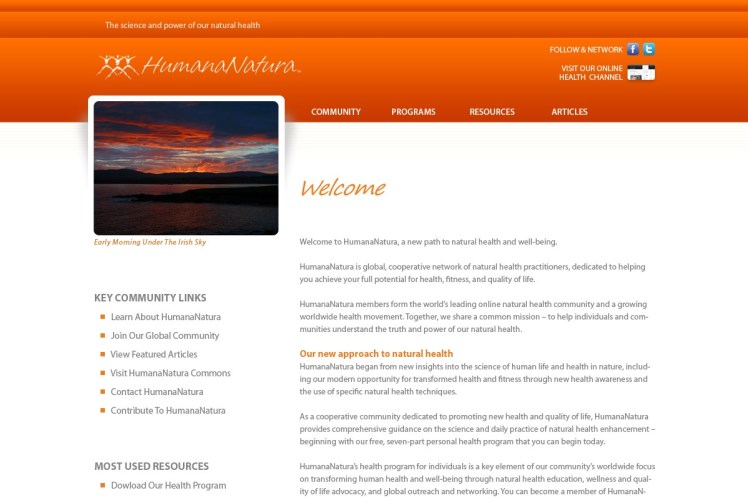
We approved work today on a new look for the HumanaNatura website. Though evolutionary, the new design improves readability and navigation, better ties the site visually to our new blog, and prepares us for planned revisions to the website’s content. Look for the new look to go live in about a month!

How to live today

With each sunrise, the world asks us how we will live that day…what we will do and not do, will spend our time one way or another. We can use the day to increase our health and quality of life, and that of others, or spend our time less wisely and productively…how do you mean to live today?

Stagnation or innovation?

A nice summary of Tyler Cowen’s controversial new e-book, The Great Stagnation, is available at NYT The Experience Economy. Cowen proposes that the world has already fundamentally changed in developed nations…even that a post-industrial, post-materialist age began in the mid-1970s. Many see signs of stagnation in the developed world today, but does this view miss an entirely new future – one that is already robust and here, just not widely distributed yet?