Evolution Is Sexy

An interesting new study has found that evolution is naturally sexy, or rather that it naturally encourages open sexual reproduction. This idea is of course well-evidenced by the development and preponderance of sexual reproduction in all higher species on earth, but remains the subject of theoretical issues among evolutionary scientists, since the evolution of sex seemingly produces more males than might be best for optimal gene advancement.

The new research examined reproduction in worms capable of both sexual and asexual reproduction. The researchers found that sexual reproduction led to far more robust immune system strength over time, providing significant benefits for gene advancement. As has been suggested by other research, genetic diversity proves essential to long-term natural survival, and both sex and a high number of males appear to encourage this healthy diversity.

Learn more about the new study at Sex And Evolution.

Photo courtesy of Wikimedia Deal No deal

Tell others about HumanaNatura – promote new life and health! 

Brain drain

Scientists at Harvard University have found a new correlation between childhood poverty and compromised natural brain development. The study, reported to be the first to link general conditions of poverty with a specific neurological impairment, examined brain measurements from 400 children of varying socioeconomic backgrounds and found a link between household income and functioning of the hippocampus, a critical area of the brain that controls memory and emotion. The lead researcher has proposed that “differences in the hippocampus, perhaps due to stress tied to growing up in poverty, might partially explain differences in long-term memory, learning, control of neuroendocrine functions, and modulation of emotional behavior.” Learn more about the new study, with important implications for community and childhood health policy, at Growing Up Poor.

Urban stress

A team of researchers studying sensitivity to stress has found that subjects raised in urban areas are significantly more susceptible to stress activation than counterparts who grew up in non-urban settings. The new findings are consistent with other research suggesting important natural health limitations from human life principally in urban settings and lacking regular contact with the larger natural environment. In the study, published in the new edition of Nature, researchers examined the brain scans of German students placed in challenging situations and found a clear difference in stress activation between urban and non-urban raised groups. Learn more about the new study at Urban Stress Sensitivity.

Stalling longevity

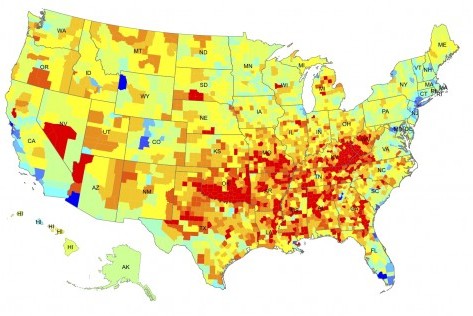
A new analysis published in the journal Population Health Metrics suggests that U.S. longevity progress has begun to stall. The researchers conclude that a decline in longevity is now occurring in absolute terms among women living primarily in southern states and representing almost 25% of the nation’s counties. They also caution that overall U.S. longevity is now broadly slipping relative to other industrialized countries and many industrializing ones, with the U.S. projected to be ranked 37th in the world for men and women based on the new analysis. Though high income inequality in the U.S. is predicted by some research to reduce health and limit progress on longevity, the new results are still startling given that the U.S. has the highest levels of health spending per capita in the world. Less surprisingly, the negative and trailing longevity trends are attributed by the researchers to increased smoking and high blood pressure among women, and to rapidly accelerating obesity overall. All are health risks that have proven resistant to traditional medical and public health efforts. Learn more about the new findings at U.S. Life Expectancy Slips or read the full report at Falling Behind.

Med-itocracy

The United States is about to move forward to make its high-cost medical system more transparent and efficient, and perhaps more focused on health outcomes and cost avoidance. The change comes from outside the system, driven by database technology and reformers seeking to shine light on how health care dollars are spent. The new measures will allow physician and hospital level analysis of outcome and cost performance, and should eventually transform the way this long poorly-accountable and intransigent system operates. Learn more about the new data transparency measures, with applicability for all nations today, at Medical Care Data Release.

Our natural place

Amidst the preoccupations and pressures of modern life, we sometimes seek escape…leading us to nature and new opportunities for renewal and perspective on life today. In this outward movement, we form and open a window on our earlier life together, our long natural history, and the essential nature of our health in all times…

New HN look

A new look for the HumanaNatura website is here, designed to better integrate it with our blog and social media pages. In about two weeks, updated personal and community health programs will join the new design. In the meantime, check out the new site at HumanaNatura.

A sunlight economy

We moved closer this week toward a profound change in the way we all may live – the shift to a non-polluting and fully-sustainable sunlight-based industrial economy. This latest step was made by the the pioneering MIT research team led by Daniel Nocera, who announced creation of a new “artificial leaf” capable of low-cost and sustainable solar production of both energy and clean drinking water. As with related technology under development by the team, this newest variation uses commonly-available and non-hazardous materials to convert sunlight into oxygen and hydrogen. The general approach is expected to eventually outperform all other energy sources, measured by energy cost and total sustainable energy production, once technology refinement and mass-production are realized. Learn more about the team’s newest success at Artificial Leaf and view an extended presentation by Nocera on our future energy options and the prospect of a sunlight-based economy at Personalized Energy.

Ranking communities

A new report by the Robert Wood Johnson Foundation and the University of Wisconsin’s Population Health Institute ranks the health of 3000 U.S. counties, based on objective measures of longevity and health factors. While the findings confirm earlier research showing that affluence and education level strongly influence public health outcomes, the rankings are not without some positive surprises. Several less affluent counties with active community health programs, for example, scored well above this general trend line, highlighting the importance of health promotion efforts and suggesting clear policy guidance for communities of all income and education levels. Learn more about the new report New Report Ranks U.S. Counties and see the data at County Health Rankings.