Ten happiest jobs

Recent news reports on the ten most and least happy professions in America, courtesy of the University of Chicago’s General Social Survey, caught many people by surprise but really shouldn’t have. After all, each of the happiest jobs identified align well with established research findings on the key drivers of human happiness. As ably summarized by Richard Layard, these natural happiness drivers include things that are community, family, and health friendly; ensure adequate financial security; provide sufficient meaningfulness and work quality; promote social currency and personal freedom; and encourage compassionate, trusting, and thankful personal attitudes.

What should be equally unsurprising, but often is still a shock and strongly counter-intuitive for many of us, is that the least happy occupations identified emphasize income, technical focus, and/or positions of diffuse accountability within large organizations, and thus generally align poorly with the above happiness drivers. But since we live in a time where our natural sources of health and happiness are still poorly understood, and where incentives for wise status-seeking life are generally absent, we routinely pursue these unhappy occupations and make other objectively poor personal choices, in and out of work.

You can click  to learn more about the most and least happy jobs in America, but here is a quick listing of the top and bottom ranked occupations in the University of Chicago survey:

Ten Most Happy Jobs

  1. Clergy
  2. Firefighters
  3. Physical therapists
  4. Authors
  5. Special Ed teachers
  6. Teachers
  7. Artists
  8. Psychologists
  9. Financial services sales
  10. Operating engineers

Ten Least Happy Jobs

  1. Information Technology Director
  2. Sales and Marketing Director
  3. Product Manager
  4. Senior Web Developer
  5. Technical Specialist
  6. Electronics Technician
  7. Law Clerk
  8. Technical Support Analyst
  9. CNC Machinist
  10. Marketing Manager

If you would like to begin to explore the science of achieving lasting and healthy happiness in your life and work, a great place to start is with Mark Lundegren’s popular article, Balancing Health & Happiness, which was published recently by HumanaNatura.

Photo courtesy of Happiness.

Subscribe to NaturaLife…get health-impacting ideas & inspiration by  email!

Power of e-coaching

It’s not the first study to suggest that electronic health coaching works, but new research coordinated by Johns Hopkins University adds to an important and growing body of evidence suggesting that electronic health messages and online  health promotion programs can greatly improve individual health and quality of life outcomes…on par with in-person interactions, but at a fraction of the cost.

In the new research, the performance of high-touch, electronic-touch, and no-touch weight-loss programs were compared across more than 400 obese men and women over a two-year period. The researchers found that the high-touch and electronic-touch programs were about equally effective at reducing weight over the period, with the no-touch approach (intended as a control group) trailing significantly behind. The new research is consistent with similar findings in other health areas – see for example Smoking Textation – underscoring the power of e-coaching for greater health.

The new study and related research point to the power of electronic media and online tools to positively alter our health orientation and behavior generally, and even to counter widespread modern messaging that encourages health-reducing attitudes and choices. We therefore encourage you to infuse your personal electronic environment with positive and health-affirming messages, perhaps beginning by receiving regular health-promoting ideas and inspiration from HumanaNatura by subscribing to NaturaLife.

You can learn more about the new research at Remote Weight Loss Works and sign up to receive HumanaNatura’s electronic health newsletter at Join Us. You can also access and explore all of HumanaNatura’s member-supported online health programs and tools for free at HumanaNatura, Personal Health Program, and Community Health Program.

Photo courtesy of Mouse.

Subscribe to NaturaLife…get health-promoting ideas & inspiration by  email!
December must-do’s

Are you clear on your must-do’s for December? In the HumanaNatura natural health system, regular personal planning and ongoing plan implementation are encouraged via our third natural health technique, Natural Living. A must-do is any action that needs to be taken or completed to fulfill our “Natural Life Plan” goals – goals that should always be SMART (Specific, Measurable, Actionable, Realistic, and Time-Specified).

Creating and implementing a Natural Life Plan with HumanaNatura involves seven repeating steps, which progressively move us to new and ever richer conceptions of our health and lives, throughout our lives. You can learn more about personal planning in this special, liberating, and scientifically-based way, via the Plans tab above.

With a new month here,  right now is a great time to consider or your re-consider your personal plans – spanning every aspect of your life and health – and how you might best spend your time this month.

You can learn more about the importance of progressive personal planning via the Natural Living section of our comprehensive Personal Health Program and access our easy-to-use planning worksheets at Natural Living Worksheets.

Subscribe to NaturaLife…get healthy ideas & inspiration in your mailbox!

Start of new cycle

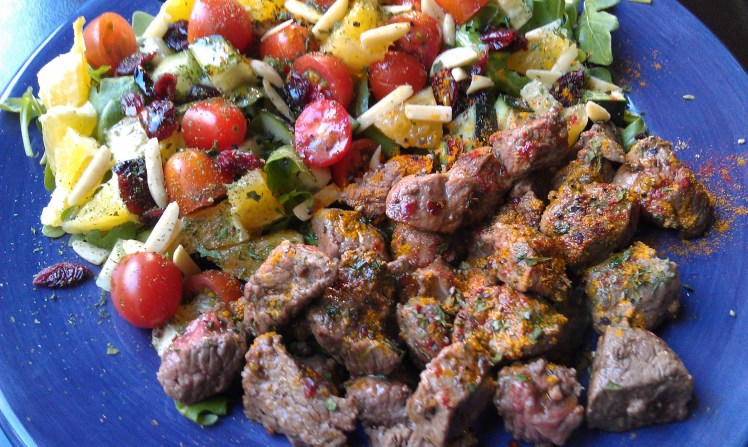
Starting off a new cycle of NaturaLife posts with a good hearty meal…featuring cubed curry beef, arugula, grape tomatoes, diced cucumber and orange, and dried cranberries…garnished with slivered almonds, parsley, paprika, coriander, and black pepper…

Learn about our guidelines for healthy natural nutrition and how to make delicious salad meals via our popular article Perfect Salad Meals or through the Natural Eating section of HumanaNatura’s comprehensive Personal Health Program.

Subscribe to NaturaLife…get healthy ideas & inspiration in your mailbox!

On holiday

HumanaNatura is on holiday for the remainder of November. Regular breaks from our routines are a chance for fun, unplanned experiences, and new perspectives. If you struggle to make time for breaks and healthy non-work time in your life, learn how you can move to a 1000 hour work-year – working six hours a day, four days a week, and forty weeks a year – via Mark Lundegren’s popular article The Real New Economy. Wishing you new health, and see you in December!  HumanaNatura

Please share this post…and the science and rhythm of healthy life!

Big and beefy

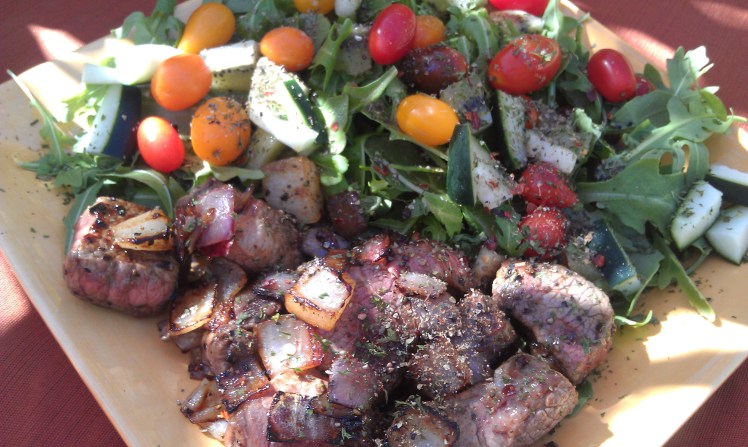
Though there is a natural limit to the amount of red meat we should eat, it is not zero…especially when it comes to lean meats. This satisfying salad meal starts with a big bed of arugula and adds julienne cucumber, diced kiwi, and mixed cherry tomatoes. It includes a sauté of cubed beef and red onion…and is garnished with parsley, marjoram, coriander, and red and black pepper. Yum!

Learn about our guidelines for healthy natural nutrition and how to make delicious salad meals via our popular article Perfect Salad Meals or through the Natural Eating section of HumanaNatura’s comprehensive Personal Health Program.

Please share this post…and the simplicity and pleasure of natural eating!

Correlation

At HumanaNatura, our goal is to both inspire and inform, so that each of us makes progressively healthier and higher quality choices over time. This strategy is in keeping with the scientific foundations of our natural health system, and with research suggesting that a mix of good facts and feelings best steers us toward improved life and health.

A new study by Harvard University affords a nice informational or teachable moment, one that can help us better understand and make use of the health research we encounter. In the new study, public health researchers found that reported soft drink consumption in teens was closely associated with reported violent behavior. For our discussion, the key words from the study are “associated” and “reported.”

When researchers state an association or correlation like this, they are indicating that two or more things have been observed moving together in a pattern. Correlations can be positive (with things moving in the same direction) or negative (moving in opposite directions) but they cannot be neutral (since no movement means no correlated or concurrent change). Importantly, association or correlation never means that causation or cause and effect has been established (that A causes B, or the reverse). In reporting on the new study, the researchers took pains to highlight that they have not shown causation between soft drinks and teen violence, in either a forward or backward direction.

When studies like this talk about a reported behavior or condition, they mean just that. Participants were asked one or more questions and gave a reply or report. As you might suspect, what we say we do and what we actually do can be substantially at odds with one another, either because we are intentionally withholding or exaggerating information, or because we have a distorted recollection or sense of the information. A much more reliable source of information is observed or measured behavior or data, and even better than this are observations and measurements that are double-blind (where neither the observed person nor observer is privy to key details of the measurement process).

If correlational and reported behavior studies are each less valuable than available alternatives, why have them at all? First, because they are often easier and much less expensive to perform. Second, they can suggest areas for more intensive follow-up research. And in the case of correlational research in particular, while it does not provide causal information, it can lead to insights that are quite useful. In this case, researchers have discovered that quite innocuous information about soda consumption may be a signal for teenagers that are at risk of acting violently, potentially leading to better directed social service interventions.

If you would like to learn more about research techniques to investigate correlation and causation, check out Correlation Does Not Imply Causation.

Please share this post…and the science of creating healthier modern life!

More than skinny

A newly released five-year study underscores there is more to health than being skinny, for men and women.

In the new research, scientists at the University of Oklahoma tracked the habits of roughly 4,000 middle to older-aged women. They found that daily consumption of sugary drinks was associated with a four-fold increase in blood fats know as triglycerides, important markers for cardiovascular disease. Importantly, the researchers observed that this association held for women who were not overweight, suggesting that an absence of visible weight-gain from these drinks does not signal an absence of underlying health impairment.

Though news reports have focused on the finding related to skinny women, we would note the study also found that sugary drink consumption was highly and expectedly correlated with increased waist fat and fasting glucose levels overall – indicators of increased cardiovascular and diabetes risks, respectively. The new study contrasts nicely with other research showing atherosclerosis (blood vessel plaques) among skinny people on unnatural diets that reduce carbohydrates but allow high dietary fat intake. In both cases, the lesson is clear: skinny does not always mean healthy.

Learn about the new study at Sugary Drinks Hurt Skinny Women and explore delicious health-promoting natural alternatives to junk foods of all kinds via the Natural Eating section of HumanaNatura’s four-part Personal Health Program.

Photo courtesy of Skinny Jeans.

Please share this post…and the science of healthy modern living!

Warm ‘n cool

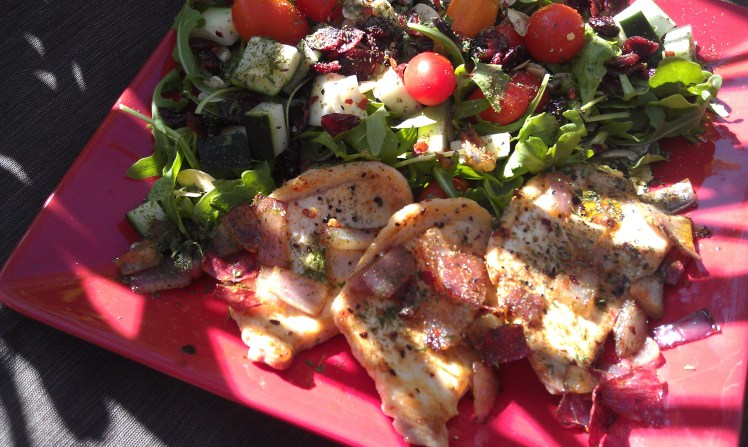
Yummy sliced pork and red onion saute with a bed of arugula, mixed cherry tomatoes, diced cucumber, and dried cranberries…garnished with sliced almonds, coriander, and red and black pepper.

Learn about our guidelines for healthy natural nutrition and how to make delicious salad meals via our popular article Perfect Salad Meals or through the Natural Eating section of HumanaNatura’s comprehensive Personal Health Program.

Please share this post…and the science and simplicity of healthy eating!


Seeds of life

Have you considered exactly how life began on earth? Core evolutionary principles explain the way non-living organic and pre-organic compounds can naturally combine and become selected for growth. But there is an ongoing question regarding the degree to which the seeding of our earth with organic compounds from space contributed to life’s inception here.

Early evolutionary scientists often considered the earth in isolation and presumed that organic compounds primarily evolved on earth from inorganic ones, via chance encounters of these simpler molecules (a process known as abiogenesis). But more recent research has suggested that our universe may more actively provide planets with advanced organic compounds, via supernovae and the gradual formation of complex molecules in interstellar dust clouds. A newly published analysis by the University of Hong Kong supports this changing view.

In the new analysis, researchers examined infrared studies of interstellar dust and found evidence of more complex organic materials than was previously appreciated. The analysis used a novel technique that compared newer dust clouds with older ones, which indicated considerable organic compound formation in these clouds over time. This research suggests significant development of organic compounds in space – or that our universe naturally and widely contains and provides the seeds of life.

You can learn more about the new study at Organic Dust and trace the development of natural life and health on earth via the Our Past section of HumanaNatura’s science-based Personal Health Program.

Please share this post…and the science of natural life and health!