Seafood mix

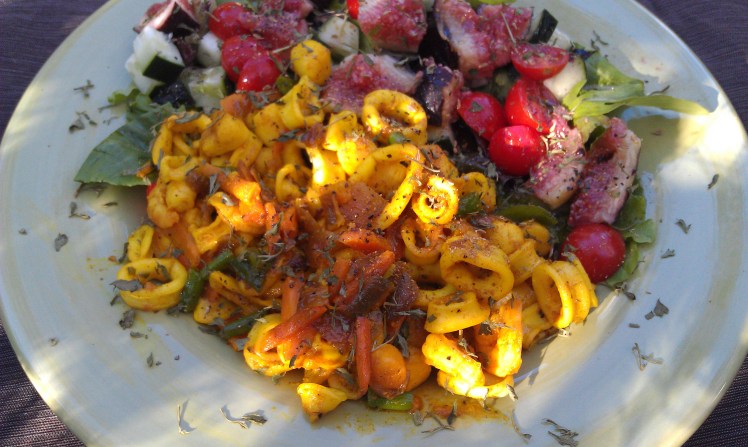
Tasty mix of curry-seasoned shrimp, scallops, squid, and chopped veggies served with baby greens, diced cucumbers, halved grape tomatoes, and quartered fresh figs…garnished with parsley, coriander, anise, and black pepper. Quick, delicious, and about as healthy as a meal can be…with food chain-low fish and a high raw vegetable content.

Learn about our guidelines for healthy natural nutrition and how to make delicious salad meals via our popular article Perfect Salad Meals or through the Natural Eating section of HumanaNatura’s comprehensive Personal Health Program.

Please share this post…and the science and simplicity of natural eating!

Natural attention

Most of us mean to live optimally, especially people using or exploring HumanaNatura’s natural health techniques. But our desire to make the most of our brains and bodies must confront the fact that this effort relies on them, and thus is subject to certain natural limitations and biases. We may feel clear, objective, and in control, but we know through science that this can only be partially true. Without a certain amount of humility and curiosity about our natural limits, and ongoing attention to them, we individually and collectively risk living far below our potential.

A simple but revealing example of the everyday natural limits we each face in optimizing our lives comes from a new study by the University of Minnesota. Researchers there compared reported versus actual attention to nutritional information. They found that even self-reported “health conscious” shoppers assimilated much less information than they believed. The team concluded that we are far more apt to consume information that is at the top of lists and when it is presented advantageously, confirming the general conclusions of considerable and still growing research regarding our natural cognitive and perceptual biases.

The new findings shouldn’t be a surprise, since we are not evolved for perfection or even special accuracy amidst modern life, and because there is so much established science predicting exactly these results. Another predicted finding from this field: many of us reading this story will feel exceptional and that the results don’t apply or aren’t important to us. This natural bias explains why a large majority of us believe we possess above-average intelligence and attractiveness. Such native optimism may have had survival advantages in band life on the plains of Africa, but ultimately is one of many natural biases that has important quality of life implications today – for example, causing our frequent under-appreciation of health risks or the persistence required to make positive changes stick.

Learn more about the new study at What Am I Missing, and explore our options for more attentive life via HumanaNatura’s popular article Understanding Personal Empowerment or the Natural Living section of our comprehensive Personal Health Program.

Photo courtesy of Attentive Mind.

Please share this post…and the science of healthy modern life!

Orange cod

Delicious fresh cod, seasoned with curry and herbs and broiled until just flakey, served with mixed greens, julienne celery and cucumber sections, red onion bits, and quartered grape tomatoes…garnished with orange rind and juice, parsley, coriander, black pepper, and a good amount of anise. Yummy, healthy and done in under fifteen minutes!

Learn about our guidelines for healthy natural nutrition and how to make delicious salad meals via our popular article Perfect Salad Meals or through the Natural Eating section of HumanaNatura’s comprehensive Personal Health Program.

Please share this post…and the science and simplicity of natural eating!

Place matters

In HumanaNatura’s natural health system, the fourth and final of our science-based health techniques is called Natural Communities. This health-critical practice begins with the idea that our social environment is essential to our health, and guides practitioners in the steps to either find or create a healthier community setting.

The science of healthy groups and communities, and the study of their important health and quality of life impacts, is quite broad – ranging from public health and city planning studies to management and political science research – making it difficult for health professionals and the general public to appreciate its full scope and importance. A new study by University of Chicago researchers is thus useful because it makes the power of place more tangible, and reminds us that we may naturally habituate to poor quality conditions and underestimate the power of community life on our health more generally.

The new study specifically investigated obesity and diabetes changes among families in poor U.S. neighborhoods who were given the opportunity to move to less poverty-prone areas in the 1990s. Some did so, while others did not, creating a natural experiment in the impact of relocation and background community quality. Ten years later, the research team found significant improvements in diabetes and obesity rates (of about 20%) among the group that had moved. This impact is reportedly about equal to the expected change from standard medical interventions, and the findings are important enough to warrant investigation of other health consequences in this group.

Do you want to consider the power of place in your life or more generally? Learn more about the new study at Change Your Neighborhood, Improve Your Health, and explore HumanaNatura’s guidelines for healthy communities via our unique and comprehensive Community Health Program.

Please share this post…and the science and power of healthy communities!

Grass-fed beef

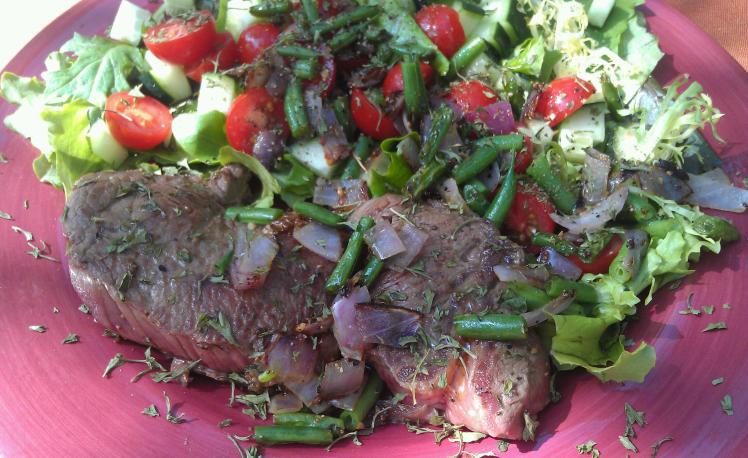
Even our conservative local supermarket has begun carrying grass-fed beef…what a difference! If yours has too, we would encourage you to make the switch. Unlike traditional beef, grass-fed animals are not unnaturally “finished” with a grain-rich diet that increases their body fat and produces richly-marbled but less healthy meat. Though a bit more expensive, if you follow HumanaNatura’s guidelines on limiting red meat frequency and right-sizing our daily protein portions, this far healthier and more natural form of beef may be a worthwhile alternative.

Learn about our guidelines for healthy natural nutrition and how to make delicious salad meals via our popular article Perfect Salad Meals or through the Natural Eating section of HumanaNatura’s comprehensive Personal Health Program.

Please share this post…and the science and simplicity of natural eating!

Water fresh

Delicious pan-cooked freshwater fish with sautéed veggies, mixed greens, julienne cucumbers, and halved grape tomatoes…garnished simply with parsley, coriander, black pepper, and lemon. Learn about our guidelines for healthy natural nutrition and how to make delicious salad meals via our popular article Perfect Salad Meals or through the Natural Eating section of HumanaNatura’s comprehensive Personal Health Program.

Please share this post…and the science and simplicity of natural eating!

Nurture thyself

Do you like the genes nature gave you? Though we perhaps all might like to make a few tweaks, the truth is that most of us have perfectly good genes – ones that will not keep us from long, healthy, and fulfilling modern lives – if we will simply and naturally nurture ourselves and our health, today and every day throughout our lives.

A great case in point comes from a new and quite large statistical analysis conducted by researchers at McMaster University in Ontario. The analysis was based on nearly 30,000 people worldwide who answered a lifestyle questionnaire and provided genetic information. In the study, the research team found that eating patterns were more strongly correlated with long-term heart health than the presence of specific genetic patterns known to increase cardiovascular risks.

The newest research can be seen as part of a growing body of related findings – covering most non-communicable diseases (NCDs) and many aspects of our cognitive health and well-being – that highlights the power and importance of lifestyle and choice, and an only secondary influence of our genes on healthy lifelong functioning. This important network of research confirms something we all know deep down, in the developed world at least: that we normally now have substantial power to control and increase our health and quality of life through our choices and actions.

Learn more about the new heart health research at Veggies May Outpower Genes. Explore the growing science of lifestyle patterns and their impact on health risks through the analyses contained in the World Health Organization’s new NCD Prevention & Control Campaign.

If you are ready to take new control of your genes and actively nurture yourself toward greater health and well-being, you can begin anytime and create a remarkable health-centered life via HumanaNatura’s four science-based natural health techniques and our complete, open-ended, and lifelong Personal Health Program.

Please share this post…communicate the science of healthy modern life!

Supplement news

A tough few days for the supplement industry last week. You may have read the news reports. One newly published study found that, in a large observational sampling of women over 60, those who took a multivitamin had a higher death rate than those who didn’t. And another new piece of research, this time involving a ten-year clinical trial, concluded that men over 55 taking vitamin E are more likely to develop prostate cancer.

To be fair, the first study has methodological shortcomings – there was no adjustment for initial health levels or use of a placebo – and the second one has a limited scope. But both are important reminders of a little secret underlying the global supplement industry: there is almost no science validating the many hypotheses that taking supplements is a good idea. Add to this a bit of new evidence suggesting the practice may not be as benign as many people previously thought, including food and drug regulators, and it really was a bad week all around for the industry.

HumanaNatura remains open to scientific research showing clear net benefits from specific supplement regimes. But perhaps like you, we have been waiting for this evidence for a while and there have been many studies seeking to find reliable and scientifically-valid supplementation strategies during this time.

Today, based on available science, we recommend two and only two nutritional supplements for adults (and none for children) using our natural health system, and both only on the advice of your physician: 1) a daily vitamin D supplement if you have inadequate sun exposure and low circulating levels of this critical vitamin-hormone, and 2) a daily low-dose aspirin, given its low-cost, limited risk of side-effects, and strong correlation with reduced cardiovascular disease and lowered large-organ cancers (both findings via randomized clinical trials).

Given the new studies and pervasiveness of supplement use (by roughly half of North American adults), many medical experts have been in the news on the topic of supplementation these last few days. By an informal reading, it appears most are saying to save your money, unless you have a known vitamin deficiency, and to focus instead on healthy eating, exercise, and lifestyle. As we have suggested, there is a lot of science upon which to base this advice.

Before you take or buy another supplement, learn more about the new studies via three news articles on the topic – Dietary Supplements RiskyShould You Take Vitamins, and Is It Time To Stop – and review HumanaNatura’s Supplement Guidelines (Item #7) in our comprehensive, science-based Personal Health Program.

Photo Courtesy of Wyeth Centrum

Please share this post…communicate the science of healthy modern life!
Nutrition first

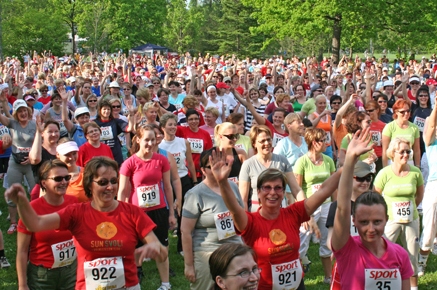
A new and nicely done article in The Independent discusses a common personal experience – finding that exercise alone will not make us naturally lean, healthy, and fit. The article includes the math and some of the science that explains why this so. The bottom line: we limit our natural fitness when we jump to exercise and do not first attend to the foundations of our natural health, especially food quality and quantity.

In practice, poor eating creates a high barrier to realizing our health and fitness potential, one that exercise usually cannot run over or around. This is in part because unnatural eating generally means excessive and unbalanced eating…often in the form of too many calorie-rich and artery-clogging fats, and too many fat-building and hunger-stoking carbohydrates.

Unnatural eating also brings foods into our diet that we are not evolved to eat, displacing natural foods required for fitness and leading to metabolic distortions that reduce our physiological health before we go out the door or to the gym. And, as the new article points out, most exercise increases rather than decreases hunger, which can ironically compound our fitness gap if our health promotion efforts did not begin by ensuring healthy natural nutrition.

Check out the new article at Does Running Make You Fat and see how HumanaNatura places natural nutrition before natural exercise in the overview to our four-part Personal Health Program.

Please share this post…and the science of healthy modern life!

Healthy fish fry

Shot this photo for our updated Meals page in the early morning sun and then had the meal for breakfast. Delicious and photogenic, but we decided not to use, so here it is re-purposed to make a specific point: you can enjoy fried fish and have your health too. Our model-meal was prepared with wild-caught bass that was pan-fried with a bit of olive oil, red onion, and seasonings. It is served with mixed greens, julienne-cut celery, whole grape tomatoes, diced figs…and garnished with sunflower seeds, parsley, coriander, and black pepper. We hope this beautiful meal is health-inspiring, and that you will check our new page tabs. They’re still being developed but you’ll get where we’re going.

Please share this post…and the power and simplicity of natural eating!